
Supplements
Magnesium Supplements for Women: What the Science Actually Shows
3 July 2026

Magnesium has become the supplement everyone is talking about. It is sold as the answer to poor sleep, stress, anxiety, period problems, muscle cramps and menopause symptoms, often all on the same label.
So the question I keep getting from women is a sensible one: do I actually need magnesium, and if I do, which one, and for what?
As a CORU Registered Dietitian, I want to give you the honest, evidence-based answer rather than the marketing version. In this article I will explain what magnesium is, why so many women fall short, what the research genuinely supports (and what it does not), who is most likely to benefit, and my honest recommendation on whether it is worth taking. Where I make a claim, I have referenced the study behind it.
What is magnesium?
Magnesium is an essential mineral, which means your body cannot make it and you have to get it from food. It is involved in more than 300 different processes in the body, including turning food into energy, regulating your blood sugar and blood pressure, supporting your nerves and muscles, and keeping your heartbeat steady. It also works a little like a natural calcium channel regulator, which is part of why it matters so much for muscle relaxation and heart rhythm.
Most of your body's magnesium (around half to two thirds) is stored in your bones, with most of the rest inside your cells. Less than 1% sits in your blood.
That last point matters more than you might think. Because so little magnesium circulates in the blood, a standard blood test is a poor measure of your true magnesium status. You can be genuinely low inside your cells while your blood test still reads "normal." So if you have ever been told your bloods are fine but still suspect you are running low, you are not imagining things. The test simply is not very good at picking it up.
Where to get magnesium from food
Magnesium is found in a lot of everyday whole foods, including:
- Dark leafy greens such as spinach and Swiss chard
- Nuts and seeds, especially pumpkin seeds and almonds
- Beans and legumes such as black beans
- Wholegrains
- Avocado
- Dark chocolate
Here is the catch. Modern food processing, soil depletion and diets high in processed foods mean many of us take in less than we used to. Dietary surveys suggest more than half of people are not getting the recommended amount, and women are particularly likely to fall short.
How much magnesium do women need?
For most adult women, the recommended daily intake is around 310mg to 320mg per day, rising slightly in pregnancy. If you do choose a supplement, the tolerable upper limit from supplements specifically is set at 350mg per day (this limit applies to supplements, not to magnesium from food, because healthy kidneys clear any excess you get from eating).
Why so many women are low in magnesium
Some women are at much higher risk of running low. You are more likely to be short on magnesium if you:
- Eat a diet low in the whole foods above and high in processed food
- Are in perimenopause or menopause. Oestrogen helps your body absorb and hold on to magnesium, so as oestrogen falls, magnesium can be lost more easily
- Take certain medications long term, particularly proton pump inhibitors (used for reflux) and some diuretics (water tablets)
- Have a gut condition that affects absorption, such as coeliac disease or inflammatory bowel disease
- Have type 2 diabetes or insulin resistance, where higher blood sugar increases magnesium loss through the kidneys
That perimenopause and menopause link is a big reason magnesium is relevant to women in their 40s, 50s and beyond, though as you will see below, it is relevant for reasons that are not always the ones being marketed.
The different types of magnesium (and why it matters)
This is the part most articles skip, and it is genuinely important. Not all magnesium supplements are the same, and the form changes both how well it is absorbed and what it is useful for.
Broadly, there are two groups. Organic forms (bound to amino acids or organic acids) tend to be well absorbed and gentle on the stomach. Inorganic forms (mineral salts) are cheaper and contain more magnesium per tablet, but are poorly absorbed and far more likely to cause diarrhoea.
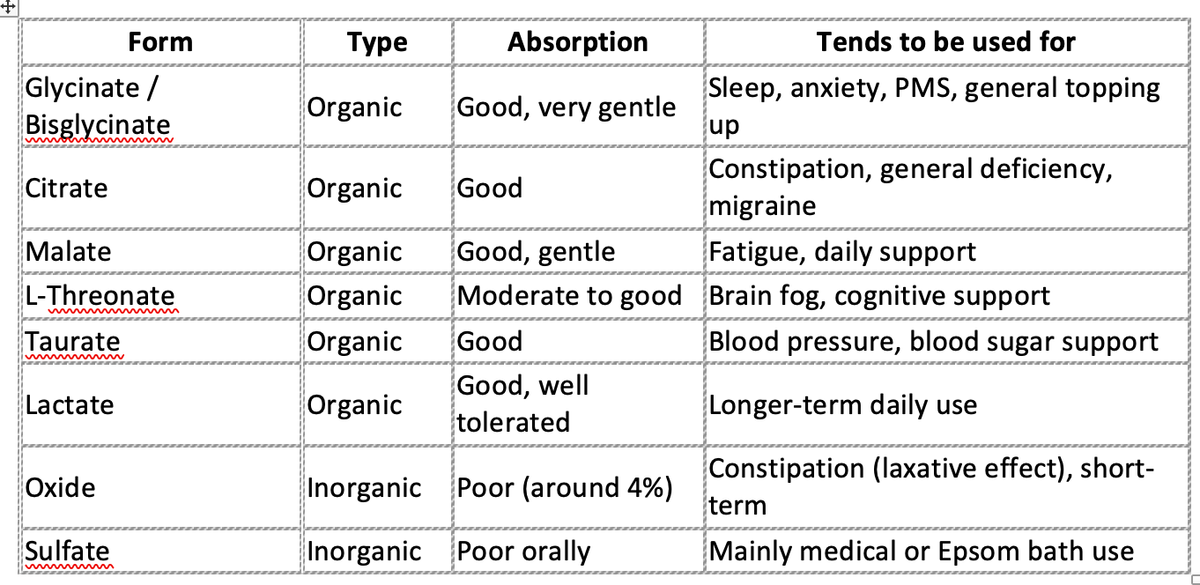
The practical takeaway: if you are trying to correct a low level or ease something like PMS or poor sleep, a gentle, well-absorbed form such as bisglycinate usually makes more sense than cheap magnesium oxide, which mostly acts as a laxative and can leave you running to the loo before it does much else.
What can magnesium actually help with?
Here is where honesty matters, because the evidence is genuinely strong for some things, promising for others, and weak for a few of the claims magnesium is most often sold on. I have grouped the evidence by how solid it is.
Strong evidence
Constipation. Magnesium is a genuinely effective, low-cost way to ease constipation. In a double-blind trial of women with functional constipation, magnesium oxide improved symptoms in around 71% of women compared with 12% on placebo (Mori et al., 2019). It works as an osmotic laxative, drawing water into the bowel. Worth knowing this is a short-term fix for constipation, not a way to correct a nutritional deficiency.
Blood sugar control. For women with type 2 diabetes, prediabetes or insulin resistance, magnesium supplementation has been shown to modestly lower fasting blood glucose in a meta-analysis of 23 trials, though the effect on longer-term markers was smaller (Al Maqrashi et al., 2023). It genuinely helps, but it is a support alongside the bigger levers of diet and activity, not a replacement.
Moderate evidence
Migraine, including menstrual migraine. For premenopausal women in particular, higher magnesium intake is linked to fewer migraines, and trials of magnesium citrate (around 600mg a day) have reduced how often and how severely migraines strike. Interestingly, the benefit appears in premenopausal but not postmenopausal women, suggesting oestrogen changes the picture. For migraines tied to your cycle, taking magnesium daily from mid-cycle can act as a mini preventative.
PMS. In women with confirmed PMS, magnesium (often combined with vitamin B6) has been shown to reduce premenstrual mood symptoms such as anxiety and low mood, taken during the second half of the cycle (Facchinetti et al., 1991). One honest caveat: blood magnesium levels do not reliably reflect PMS symptoms, so this is not something a blood test will confirm for you.
Blood pressure, but only for some. Magnesium lowers blood pressure mainly in women who are both hypertensive and low in magnesium to begin with. In women with normal blood pressure and adequate magnesium, it does not meaningfully move the needle. So it is helpful for a specific group, not a general blood pressure fix.
Bone health after menopause. This is an important one for women. Magnesium is part of the bone matrix, and in postmenopausal women, supplementation has been linked to improved bone mineral density (Stendig-Lindberg et al., 1993), with lower magnesium levels seen in women with osteoporosis. It works best as part of the bigger bone picture, balanced with calcium rather than taken in isolation. One caution: more is not better, as very high doses of magnesium oxide have been linked to worse bone outcomes in older adults, likely through overload.
Limited or mixed evidence
Sleep. This is probably magnesium's most famous use, and here I have to be straight with you: the evidence is weaker than the marketing suggests. A meta-analysis found magnesium helped people fall asleep about 17 minutes faster, but the quality of the studies was low to moderate (Mah et al., 2021). A more recent trial of magnesium bisglycinate did not reach the threshold for a clinically meaningful improvement, and because the supplement also contained a large dose of glycine (which aids sleep on its own), the small benefit could not be pinned on magnesium. More than half of the improvement was down to the placebo effect (Schuster et al., 2025). None of this means it cannot help you personally. It is low risk to try a gentle form. It just means you should keep your expectations realistic.
Stress, anxiety and low mood. Similar story. Magnesium looks helpful in open-label studies where everyone knows they are taking it, but the effect shrinks dramatically in strict placebo-controlled trials, which points to a strong placebo response (Moabedi et al., 2023). There may be a genuine benefit for some women, particularly if they were low to begin with, but the evidence does not support magnesium as a reliable treatment for anxiety or depression.
Not supported by the evidence
Menopausal hot flushes and night sweats. This one surprises people, because magnesium is heavily marketed to women in menopause. A large, well-designed, independent trial found that magnesium oxide was no better than placebo for hot flushes (Park et al., 2015). An earlier small study had suggested a benefit, but it was not blinded and did not hold up. So if hot flushes are your main issue, magnesium is not the answer, and it is worth knowing that before you spend on it.
Ordinary muscle cramps. For everyday leg cramps in adults, a high-quality Cochrane review concluded magnesium is very unlikely to help (Garrison et al., 2020). The exception is leg cramps in pregnancy, where magnesium does appear to reduce them.
Who is magnesium beneficial for?
Pulling that together, here is who is most likely to genuinely benefit.
You are more likely to see a benefit if you are:
- A woman whose diet is genuinely low in magnesium-rich whole foods
- On long-term medication that depletes magnesium (such as certain reflux tablets or water tablets)
- Living with a gut condition that affects absorption
- Managing type 2 diabetes, prediabetes or insulin resistance
- A premenopausal woman with migraines or troublesome PMS
- A postmenopausal woman thinking about bone health
- Dealing with constipation and looking for a short-term option
You probably do not need to rush out and buy it if you are:
- Hoping it will fix menopausal hot flushes (the evidence says it will not)
- Expecting it to cure anxiety or reliably transform your sleep
- Already eating well, feeling well, and not in any of the higher-risk groups above
And here is the part I always come back to as a dietitian. For most healthy women, food comes first. Adding more magnesium-rich foods to your plate (a handful of pumpkin seeds or almonds, more dark leafy greens, beans, wholegrains and yes, some good dark chocolate) is a safe, effective way to support your magnesium levels without any risk of taking too much. Your body is very good at clearing excess magnesium from food. Supplements are for filling a genuine gap, not for replacing a good plate.
Is magnesium safe, and who should be careful?
For most women, magnesium supplements are well tolerated, with the most common side effect being loose stools, especially with poorly absorbed forms like oxide. But magnesium is not automatically safe for everyone, and there are a few things I want you to know before you start.
Kidney function is the big one. Your kidneys clear excess magnesium. If your kidneys are not working well, magnesium can build up to dangerous levels. Anyone with reduced kidney function should only take magnesium under medical supervision.
Some medications and magnesium do not mix well, or need spacing out. Magnesium can interfere with the absorption of several medicines, including some antibiotics, thyroid medication (levothyroxine), certain bone medications (bisphosphonates) and others. The usual advice is to take them at different times, but this is exactly the kind of thing to check with your pharmacist or GP.
A few conditions need caution, including certain heart rhythm problems and the neuromuscular condition myasthenia gravis.
None of this is meant to frighten you. Magnesium is a well-established supplement. It simply means that if you take regular medication or have a health condition, a quick word with your GP, pharmacist or dietitian first is the sensible move.
How much magnesium, and which form?
If, after all that, magnesium looks right for you, here is the practical shape of it, though the specifics are worth confirming with a professional who knows your situation:
- Match the form to the goal. A gentle, well-absorbed form such as bisglycinate suits sleep, PMS and general topping up. Citrate suits constipation and general deficiency. Oxide is mostly a laxative.
- Most studies used doses in the range of roughly 200mg to 400mg of elemental magnesium a day for general use, with the supplement upper limit set at 350mg a day.
- For cycle-related PMS or migraine, magnesium is often taken during the second half of the cycle.
- Give it time. Benefits for things like blood sugar or bone health build over months, not days.
- Check the elemental magnesium on the label. This is the amount your body actually gets, and it can be very different from the total weight of the tablet.
So, should you take magnesium? My honest take
Here is where I land as a dietitian.
Magnesium is one of the more legitimately useful supplements out there, but its usefulness is specific, and it has been badly oversold. The honest picture looks like this:
- Genuinely helpful, for the right person: constipation, blood sugar support in type 2 diabetes, migraines and PMS in premenopausal women, and bone health after menopause.
- Weaker than the marketing suggests: sleep, anxiety and low mood. It may help some women, it is low risk to try a gentle form, but do not expect a transformation.
- Not supported: menopausal hot flushes and everyday muscle cramps.
If you are a healthy woman eating a varied diet, you very likely do not need a supplement, and adding more magnesium-rich foods is the better first step. If you are in one of the higher-risk groups, or dealing with one of the issues where the evidence is genuinely strong, a well-chosen, well-absorbed form can be worth it, ideally after a quick check with your GP or dietitian, especially if you take other medication.
Back yourself to make an informed choice here. You do not have to buy into every claim on the label, and you do not have to dismiss magnesium either. You just need to know which of its many promises the evidence actually stands behind, and now you do.
Frequently asked questions
Which magnesium is best for women? It depends on what you want it for. Magnesium bisglycinate is gentle and well absorbed, which suits sleep, PMS and general topping up. Magnesium citrate is a good all-rounder and useful for constipation. Magnesium oxide is cheap but poorly absorbed and mainly acts as a laxative.
Does magnesium really help you sleep? The evidence is weaker than the marketing suggests. Some studies show a small benefit, but much of it appears to be down to the placebo effect or to other ingredients such as glycine (Mah et al., 2021; Schuster et al., 2025). It is low risk to try a gentle form, but keep your expectations realistic.
Does magnesium help with menopause? Not for hot flushes or night sweats, which a large independent trial found it did not improve (Park et al., 2015). It is still relevant around menopause for other reasons, particularly bone health, and because falling oestrogen makes low magnesium more likely.
What are the signs of low magnesium? Low magnesium can be hard to spot and a standard blood test often misses it. Higher risk groups include women on certain long-term medications, those with gut conditions or type 2 diabetes, and women in perimenopause and menopause. If you are concerned, speak to your GP or dietitian rather than self-diagnosing.
Can I get enough magnesium from food? For many women, yes. Nuts, seeds, dark leafy greens, beans, wholegrains and dark chocolate are all good sources, and your body safely clears any excess you get from food. Supplements are for filling a genuine gap.
How much magnesium do women need per day? Around 310mg to 320mg a day for most adult women. If you supplement, the upper limit from supplements specifically is 350mg a day.
Is it safe to take magnesium every day? For most women, yes, though loose stools are the most common side effect. Anyone with reduced kidney function, certain heart conditions, or who takes regular medication should check with a professional first, as magnesium can interact with some medicines.
The bottom line
Magnesium is genuinely useful, but only for the right woman and the right reason. It is a real help for constipation, blood sugar, migraines, PMS and bone health, weaker than advertised for sleep and anxiety, and no use at all for hot flushes. For most healthy women, food comes first, and a supplement is there to fill a real gap rather than to chase every promise on the packaging.

Written by
CORU Registered Dietitian
Sinéad O'Donovan is a CORU Registered Dietitian with a first-class MSc in Clinical Nutrition and Dietetics and the founder of Nourish to Flourish, a dietitian-led nutrition programme for women. She helps women cut through the noise of the wellness industry with honest, evidence-based nutrition advice.